
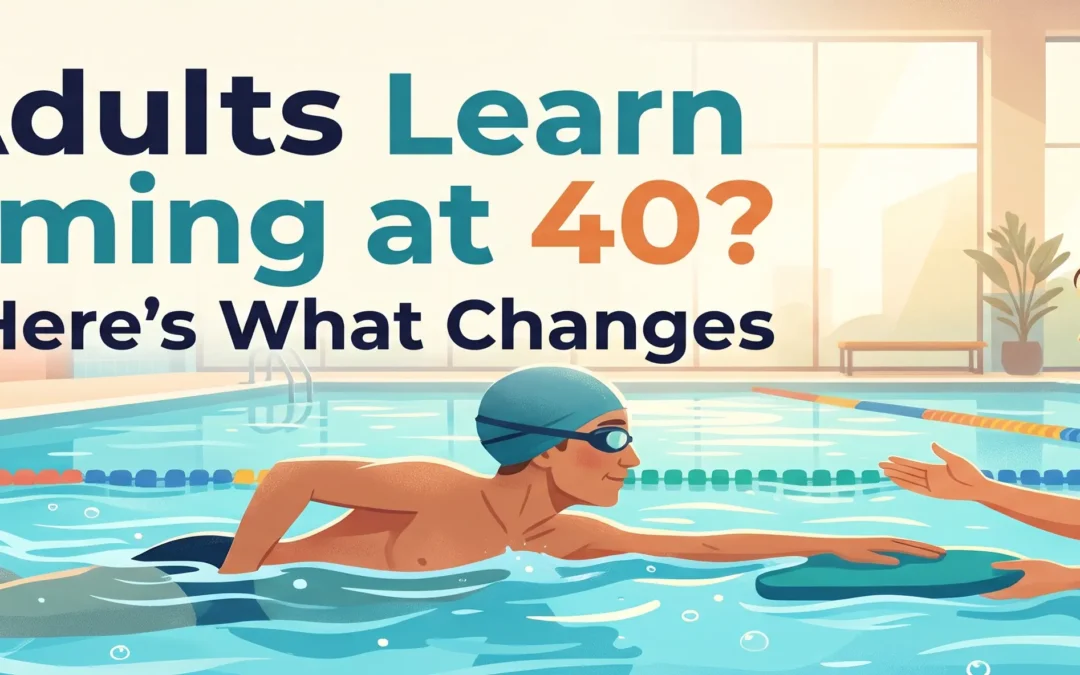
You’re 40, your children swim better than you do, and you’ve spent years holding the towels at the side of the pool. So can adults learn swimming at 40? Adults learn to swim in their forties and well beyond, and the main thing standing in the way is rarely the body.
What changes after 40 is how you learn. Fear, old memories and the belief that you’re “not a swimmer” slow adults down far more than stiff shoulders do. Below is what to expect, how long it can take, and what a sensible first goal looks like.
Can adults learn swimming at 40 as easily as younger beginners?
Physically, a beginner at 40 can learn the same basic skills as a beginner at 20. Floating, kicking, breathing out under water and swimming a first length don’t need youth. They need practice and a coach who doesn’t rush you.
The harder part is in your head. In a 2022 Woman & Home feature, three women who learned as adults described the same obstacle.
Emma Levings, 48, said she had always told herself she wasn’t a swimmer. Pauline McGonagle, who started in her forties, said she was “afraid of swimming and large expanses of water”. Minreet Kaur, 41, had always felt swimming wasn’t for someone like her.
None of them mentioned age as the problem. Each one mentioned a story they’d been telling themselves for years.
A bad childhood experience is common too. In a Gulf News report from Dubai, author Taghred Chandab explained that she nearly drowned at eight during a school swimming carnival in Sydney. She then put off learning for 25 years. When she finally booked lessons, she could swim 25 metres in a 1.8 metre deep pool by her fifth lesson.
Adults who can’t swim are also far more common than most people assume. Gallup’s analysis of the Lloyd’s Register Foundation World Risk Poll found that 55% of adults worldwide said they could not swim unassisted.
The data comes from 2019 interviews with more than 150,000 people in 142 countries. The poll didn’t publish a separate figure for the UAE, so treat it as a global picture. Still, in a city where people arrive from every corner of the world, the adult beginner in the next lane is a normal sight.
How long it takes an adult to learn
There’s no fixed answer, and anyone who gives you one without meeting you is guessing.
The examples above show the spread. Emma Levings learned in about two and a half months, but she took five lessons and practised at least five times a week because she was training for a sprint triathlon. Pauline McGonagle, who had no experience at all, took about a year. Chandab managed 25 metres within five lessons.
Swim instructor Nicole Martin, quoted in the same Woman & Home piece, put it down to effort and attendance more than the number of lessons. That matches what you’d expect. One lesson a week with no practice between sessions moves slowly. Two sessions a week, even short ones, keep the skills fresh.
Plan for months, not weeks. If it turns out faster, enjoy it.
What your first adult lessons look like
At ANSA, adult beginners join Aqua Adult. The programme is designed for people who want to get over a fear of water, as well as those swimming for fitness or leisure. Sessions last 60 minutes in a temperature-controlled pool, with a ratio of eight swimmers to one coach and a flexible schedule. Teaching starts from the basics.
Aqua Adult runs at most of ANSA’s pools across Dubai and Abu Dhabi, including Zabeel, Oud Metha, Al Qusais, Mankhool, Al Quoz, MBZ City and Bani Yas.
Expect the first sessions to feel slow on purpose. A good coach will usually work on these before any real stroke:
- standing and walking in the shallow end until you’re relaxed
- breathing out slowly with your face in the water
- floating on your front and back, with support at first
- kicking while holding the wall or a board
Don’t rush the breathing work. It decides whether you can swim a second length. If you hold your breath with your face down, you’ll come up gasping after a few metres. Learning to breathe out steadily under water feels pointless for a week and then suddenly makes everything else work.
If you’d feel more at ease with a female instructor, ANSA has lady coaches available. That matters more than it might seem. Gallup’s analysis found that only 32% of women worldwide said they could swim unassisted, compared with 57% of men. A woman starting lessons at 40 is joining a very large group.
A better first goal than “learn to swim”
“Learn to swim” is vague, which makes progress hard to see. A clearer target is the set of five water competency skills used by the American Red Cross:
- Enter water over your head by stepping or jumping in.
- Return to the surface and float or tread water for one minute.
- Turn in a full circle and find an exit.
- Swim 25 yards (about 23 metres) to the exit.
- Get out of the water, without using a ladder if you’re in a pool.
These skills are about getting yourself out of trouble, not looking elegant. They’re also a confidence test. Once you can jump into deep water, float for a minute and swim to the side, the fear that kept you out of the pool loses most of its grip.
When the Red Cross surveyed 1,024 American adults in 2014, 54% either couldn’t swim or didn’t have all five skills. It’s US data, but it shows the bar is less common than people think. Plenty of adults who say they “can swim” couldn’t pass it.
Why it’s worth doing at 40
Swimming suits a body that’s starting to complain about running. The US Centers for Disease Control and Prevention notes that people can exercise longer in water without extra joint or muscle pain. Its guidance also says water-based exercise can help people with arthritis use affected joints with less pain, and can improve health for people with diabetes and heart disease.
For older adults, the CDC says water exercise can improve quality of life and reduce disability, and may help maintain bone health in post-menopausal women. If you have a heart condition or another health concern, check with your doctor before you start, as you would with any new exercise.
There’s a practical reason too. Chandab told Gulf News she wanted to be able to help a child or another adult in an emergency. For parents who’ve spent years at the poolside, that reason alone can be enough.
Questions adult beginners ask
Is 50 too late to learn?
Pauline McGonagle started in her forties and was still swimming in her fifties. The skills and the approach are the same at 50 as at 40.
Do I need to get fit before I start?
You don’t. Aqua Adult starts from the basics, and early sessions are gentle. Your fitness will improve as you learn, which is one of the reasons to start.
Will I be the only beginner in the class?
Unlikely. Aqua Adult is built for beginners and people with a fear of water, so you’ll be grouped with swimmers at a similar level after your assessment.
Your next step
Book an assessment at the ANSA pool nearest you. Tell the coach plainly how you feel about deep water, and ask for the five Red Cross skills to be your first target. Then book two sessions a week for the first month and see how far a few weeks of steady practice takes you.