
At ANSA, a child leaves Aqua Bubble once they can swim 25 metres of freestyle. All five swimming levels for kids at ANSA work this way. Each one has a finish line measured in metres or strokes, and a child moves up when they reach it.
Age matters at the start. ANSA’s kids classes begin at 4.5 years. After that, progress depends on what your child can do in the water, not on their birthday. Below is what each level teaches and where the big step up happens.
The five ANSA levels at a glance
| Level | Session | What children work on | Finish line before moving up |
| Aqua Bubble | 45 minutes | Water safety skills and first freestyle | Swim 25m freestyle |
| Aqua Star | 60 minutes | Backstroke, streamline push-offs, underwater glides, dives | Swim 50m freestyle and 50m backstroke |
| Aqua Tech | 60 or 90 minutes | All four strokes plus turns, with dryland core work | Ready for a competitive development programme |
| Aqua Swift | 90 minutes, at least 5 to 6 sessions a week | Speed and endurance | Promotion to Aqua Rapid |
| Aqua Rapid | 120 minutes, at least 8 to 10 sessions a week | Training for competition at state level and above | The top squad |
Here are ANSA’s swimming levels for kids side by side. The first three levels are about learning to swim well. The last two are training squads. That difference is the most useful thing a parent can understand about this pathway, and it gets its own section below.
Aqua Bubble: where most children start
Aqua Bubble is ANSA’s first level for young beginners from 4.5 years old. Sessions last 45 minutes, with a ratio of five children to one coach. The focus is safety in the water first, then the beginnings of freestyle.
The exit test is simple to picture. Your child swims 25 metres of freestyle, which is one length of a standard 25m pool. When they can do that, they’re promoted to Aqua Star.
That target lines up with what the American Academy of Pediatrics says about readiness. Its swim lesson guidance on HealthyChildren.org notes that most children are ready for lessons by age 4, and that by 5 or 6 most children in swim lessons can master the front crawl.
The same guidance says lessons can begin for many children from age 1. So a 4.5-year start is not the earliest possible age, and parents of toddlers shouldn’t wait for it before thinking about water safety. The AAP is also clear that lessons are one layer of protection. Close supervision around pools still matters, however good a swimmer your child becomes.
Aqua Star and Aqua Tech: turning a child who can swim into a swimmer
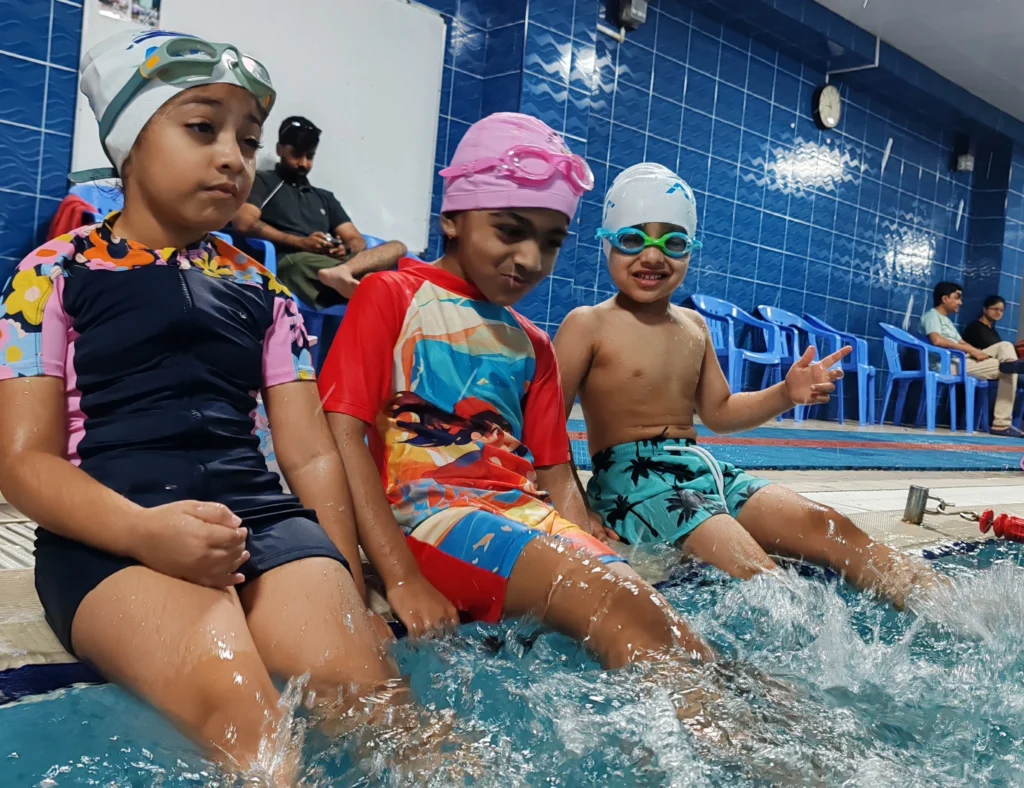
Aqua Star runs for 60 minutes and adds backstroke to the freestyle your child already has. Coaches also teach the small skills that make swimming look easy: a streamlined push-off and glide from the wall, and a first dive. To move up, your child needs to swim 50 metres of freestyle and 50 metres of backstroke. That’s two lengths of each, without stopping at the halfway wall for a chat.
Aqua Tech is where the full set of strokes arrives. Children work on freestyle, backstroke, breaststroke and butterfly, with stroke corrections, dives, turns and finishes taught to FINA competition rules. Sessions are 60 or 90 minutes and include dryland workouts for core strength. ANSA encourages Aqua Tech swimmers to enter local and school competitions, which is often the first time a child swims against the clock.
Not every child needs to go past these two levels. A child who finishes Aqua Star can swim two lengths of two strokes, and that covers a lot of what families want from lessons. A child who finishes Aqua Tech swims all four strokes with proper technique. If your goal is confidence and safety in the water, either level is a fair place to stay for a while.
The real jump comes after Aqua Tech
Look at the table again. The change is obvious. The first three levels are lessons. Aqua Swift and Aqua Rapid are training programmes, and the schedule shows it.
Aqua Swift is for swimmers who already know all four strokes and want to compete. ANSA describes it as a structured programme with a minimum of five to six sessions a week, each 90 minutes long. That’s between seven and a half and nine hours a week in the water, before you count travel. The swim bag stops being a weekend accessory and moves into the boot of the car permanently.
Aqua Rapid asks for more again: a minimum of eight to ten sessions a week, each lasting two hours, so 16 to 20 hours a week. ANSA describes it as a highly competitive squad aimed at state, national and international level, including the Olympics.
Location changes too. Aqua Bubble, Star and Tech run at all of ANSA’s venues across Dubai and Abu Dhabi. Swift and Rapid train only at two pools: the 50m Olympic-size pool at Swiss International Scientific School in Al Jaddaf, and the Al Wasl Swimming Pool in Zabeel. For a family in Al Qusais or MBZ City, that’s a real change to the weekly routine.
So before your child moves from Tech to Swift, it helps to talk through three practical questions at home:
- Does your child want to race, or do they mainly enjoy swimming?
- Can school and sleep fit around five or six sessions a week?
- Who drives to Al Jaddaf or Zabeel, and how often?
If the answer to the first question is a shrug, wait. Squad training works best when the child is the one asking for it. A swimmer who stays in Aqua Tech for an extra term loses very little. Pushing a child who isn’t keen into five sessions a week risks putting them off swimming altogether.
Swift swimmers get regular assessments and performance reviews. That gives families a clear view of progress before anyone mentions Aqua Rapid.
Aqua Rapid: the top of the pathway
Aqua Rapid is ANSA’s elite squad. Sessions are 120 minutes, and swimmers train to FINA rules for national and international meets. ANSA says the squad has a track record at the Olympic Games, Commonwealth Games, Asian Games and FINA World Championships.
Children reach Aqua Rapid by promotion from Aqua Swift. It’s the end point of the pathway rather than a class most families plan around, and that’s how it should be.
How children move up a level
Promotion at ANSA is based on skills. Birthdays don’t count. That is how well-designed swimming levels for kids should work, and it matches national learn-to-swim programmes. Swim England’s Learn to Swim framework says a child must complete all the outcomes of a stage, consistently, before they’re awarded it.
That approach is slower than moving children up by age, and it’s better. A child pushed into Aqua Star before they can manage 25 metres of freestyle spends the next term struggling, and confidence goes faster than technique arrives.
A few things help your child reach the next finish line:
- Ask the coach which skill is still missing. “Her backstroke kick drops at 30 metres” is more useful than “she’s doing well”.
- Watch a session now and then. You’ll see the drills the coach uses and can practise the same ones on a family pool day.
- Keep attendance steady. Skills build from week to week, and long gaps mean relearning.
- Celebrate the small wins, like a first dive or a first length without stopping.
New swimmers are placed after an assessment, so an older child who already swims well isn’t automatically started with the 4.5-year-olds.
Questions parents often ask
How long does each level take?
ANSA doesn’t publish a fixed timeframe, because children move up when they reach each finish line. Steady attendance makes the biggest difference, and a few missed weeks over the summer holidays can mean relearning skills. Your child’s coach can tell you how close they are.
Is there a class for children younger than 4.5?
ANSA’s kids programmes start at 4.5 years. For younger children, focus on supervised water play at home or on holiday until they’re old enough to join Aqua Bubble.
Can my child join Aqua Swift without doing Aqua Tech at ANSA?
Aqua Swift is for swimmers who already know all four strokes. A child with that experience from another programme can book an assessment, and the coach will recommend the right level.
Where to start
Book an assessment at the ANSA pool nearest you and ask the coach one question: “Which finish line is my child working towards, and how far away is it?” That answer tells you more about your child’s place in the swimming levels for kids than any level name.